The Alphabet: 26 Letters in Order
The English alphabet has 26 letters, from A to Z, and each has a capital and a small form. Milo the monkey says them in order. Then you find the letter that comes after M.
Start your free trial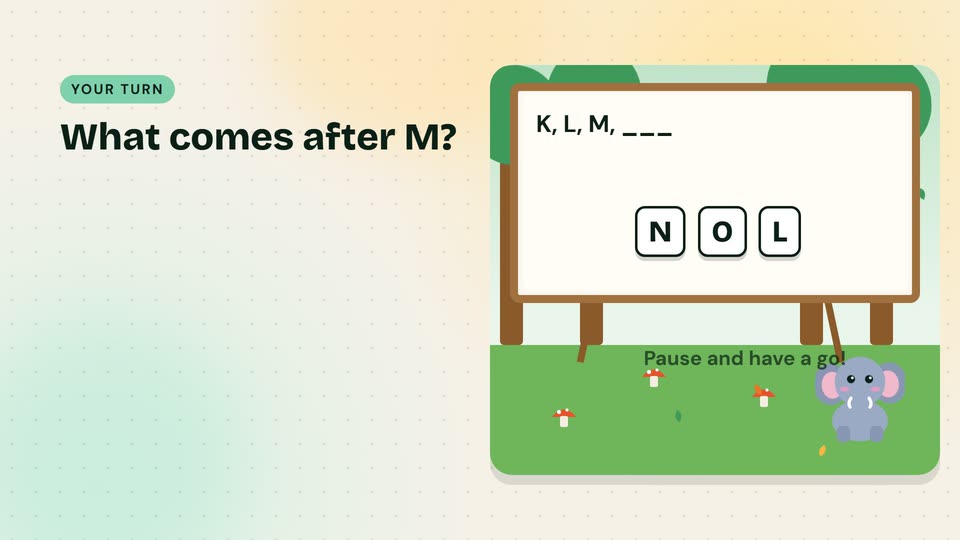
Which letter comes after M? K, L, M, ___
Watch next
 1:45
Homophones: There, Their, They’re and To, Too, Two
Fizz the fox explains homophones: words that sound the same but have different spellings and meanings. Learn there, their and they’re with an easy expanding trick, then choose between to, too and two.
 1:49
Prefixes: un-, dis-, mis-, re- and pre-
A prefix goes at the front of a word and changes its meaning. Rosie the rabbit shows un- and dis- (not or opposite), mis- (wrongly), re- (again) and pre- (before), makes "disappear", then finds the prefix that means "understand wrongly" yourself. Plus why "unnecessary" has a double n.
 1:42
Suffixes and Spelling Rules: -ous, -ful, -ness, -able and -ible
A suffix goes on the end of a word. Pip the panda learns two spelling rules: drop the e before a suffix starting with a vowel (fame → famous), and change y to i (happy → happiness). Then add -ful to "beauty" yourself, and learn the trick for choosing between -able and -ible.