Topic videos
Animated lessons that make it click.
Momo the monkey, Professor Hoot and their friends explain one topic at a time, step by step. Every video ends with a question for your child to try.
Maths
Number · 5
 1:49
Place Value to Millions
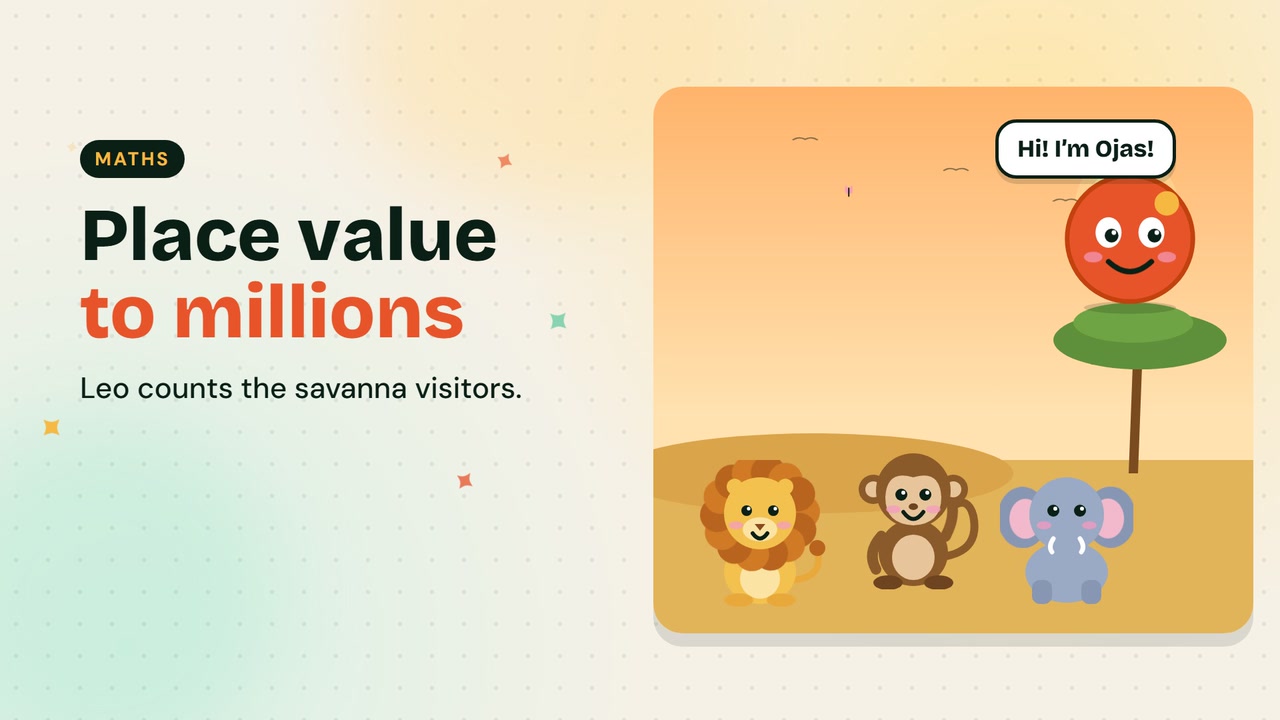
Leo the lion counts 3,452,618 visitors to the savanna. Learn what each digit is worth using a place value chart, how to read millions out loud, and how commas help. Then find the value of the 7 in 2,071,345.
 2:01
Rounding to the Nearest 10, 100 and 1,000
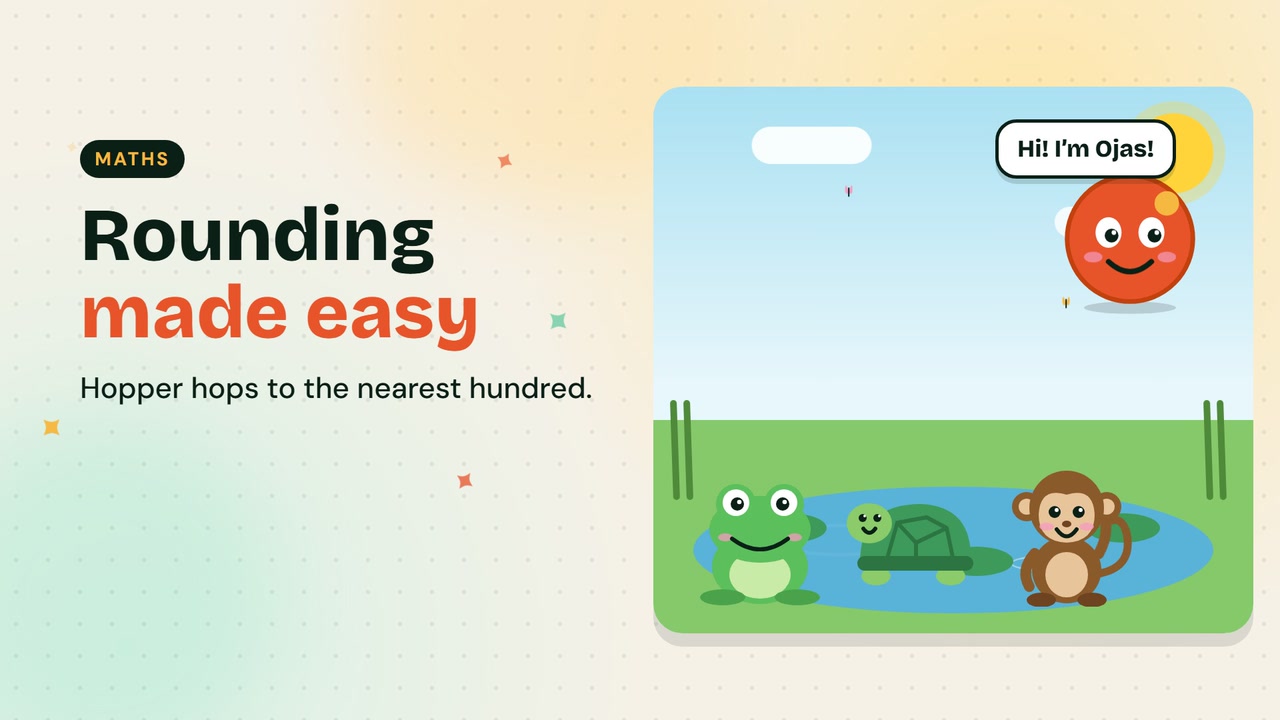
Hopper the frog rounds 3,472 to the nearest hundred on a number line. Learn the "5 or more, round up" rule, what happens with halfway numbers, and then round 6,238 to the nearest thousand yourself.
 1:42
Negative Numbers on a Number Line
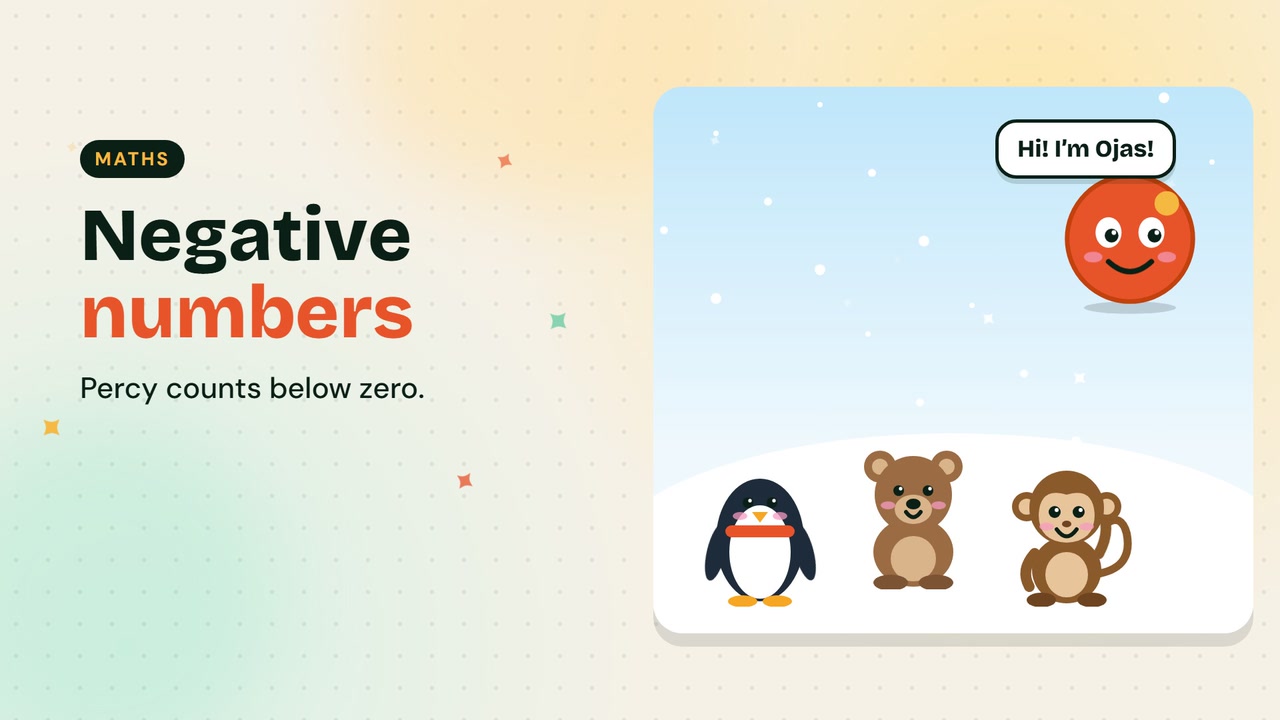
It is 3°C in the morning and the temperature falls by 7 degrees. Percy the penguin counts down through zero on a number line to reach −4°C. Learn that falling means moving left and rising means moving right, then work out a temperature rise from −5°C yourself.
 2:07
Factors, Multiples and Prime Numbers
Ellie the elephant arranges 12 peanuts into rectangles to find its factors, Hopper hops in threes to show multiples, and we find out why 7 is a prime number. Then decide whether 15 is prime.
 1:49
Square Numbers, Cube Numbers and Square Roots
Ellie the elephant builds a 3 by 3 square of tiles (3² = 9) and a 2 by 2 by 2 cube of blocks (2³ = 8). Learn what squared and cubed mean, work out 7² and the square root of 64, then find 4 cubed yourself. Plus: the number that is both a square and a cube.
Calculation · 6
 1:37
Estimating Answers by Rounding
Which is the best estimate for 49 × 21? Momo the monkey rounds each number to something friendly (50 × 20) to get about 1,000 in seconds. Learn to estimate before you calculate and to use an estimate to catch mistakes, then estimate 398 + 203 yourself.
 1:59
Order of Operations (BIDMAS)
Fizz the fox thinks 3 + 4 × 2 is 14, but Professor Hoot the owl shows why it is 11. Learn BIDMAS (brackets, indices, divide and multiply, add and subtract), then try (10 − 4) × 3 and see why equal partners go left to right.
 2:19
Column Addition and Subtraction: Carrying and Exchanging
Bruno the bear adds 476 + 358 in columns, starting with the ones and carrying when a column makes ten or more (834). Then learn exchanging for subtraction with 62 − 27, and try 503 − 168 yourself, where you have to exchange across a zero.
 1:48
Long Multiplication: Multiplying by a 2-Digit Number
Leo the lion works out 34 × 26 with the column method: multiply by the 6 ones (204), then by the 2 tens with a zero placeholder (680), then add the two parts to get 884. Then try 23 × 15 yourself and learn why the placeholder zero matters.
 2:12
Short Division: The Bus Stop Method
Bruno the bear shares 492 jars of honey between 4 friends, using the bus stop method one digit at a time, carrying remainders across. Then try 365 ÷ 5 yourself and learn to check by multiplying back.
 1:42
Times Tables Tricks for the 8 and 9 Times Tables
Momo the monkey shares two tricks for the hardest times tables. For the nines, the tens digit is one less than the number and the two digits add up to 9 (9 × 7 = 63). For the eights, double, double and double again (8 × 6 = 48). Then work out 8 × 7 yourself, and learn the 5, 6, 7, 8 trick.
Fractions, decimals and percentages · 9
 2:15
Fractions of an Amount
Momo the monkey shares 12 bananas into 4 baskets and gives 3 baskets to her friends, showing how to find ¾ of 12: divide by the bottom, times by the top. Then help Percy the penguin find ⅖ of 20 fish.
 2:00
Equivalent Fractions
Pip the panda cuts her bamboo cake into halves, quarters and eighths to show that ½ = 2/4 = 4/8. Learn the trick of multiplying the top and bottom by the same number, find how many twelfths make ¾, and see how simplifying works.
 1:43
Comparing and Ordering Fractions
Put ½, ⅜ and ¾ in order from smallest to largest. Pip the panda changes every fraction to eighths (4/8, 3/8, 6/8) so they can be compared, using fraction bars to see it. Then order 2/3, 5/6 and 7/12 yourself, and learn the shortcut for fractions with the same numerator.
 1:53
Adding and Subtracting Fractions
Rosie the rabbit shares carrot pie to show how to add fractions with the same denominator (2/7 + 3/7), and how to make the bottoms the same before adding ½ + ¼. Then work out 3/5 − 1/10 and simplify the answer.
 1:49
Multiplying and Dividing Fractions
Rosie the rabbit multiplies fractions by multiplying the tops and the bottoms (⅔ × ¾ = 6/12 = ½), then divides by a fraction using keep, change, flip (½ ÷ ¼ = 2, because two quarters fit into a half). Then work out how many eighths fit into ¾ yourself.
 1:45
Decimal Place Value: Tenths, Hundredths and Thousandths
What is the 7 in 3.472 worth? Momo the monkey puts the number in a place value chart to show it is 7 hundredths (0.07). Learn the columns after the decimal point, then find the largest of 0.45, 0.5 and 0.405 yourself, using the trick of adding zeros so every number has the same number of decimal places.
 1:56
Fractions, Decimals and Percentages
Shelly the turtle plants flowers in 3/5 of her 100-square garden to show that 3/5 = 0.6 = 60%. Learn to convert by making the bottom number 100, then convert 7/20 yourself and learn the key ones by heart.
 1:54
Percentages of Amounts
Momo the monkey finds 35% of 60 coconuts by starting with 10%, then building up 30% and 5%. A bar model shows every step. Then find 15% of 80 yourself and learn the quick ones: 50% is a half and 25% is a quarter.
 1:54
Percentage Increase and Decrease
A £40 scooter has 25% off in the sale. Fizz the fox finds 25% of £40 (£10) and takes it away to get £30. Then a £60 bike goes up by 10% to £66. Work out a 15% rise on £80 yourself, and learn the shortcut of finding 75% straight away.
Ratio and algebra · 6
 1:58
Sharing in a Ratio
Pip the panda and Rosie the rabbit share 20 strawberries in the ratio 2 : 3. A bar model shows the three steps: add the parts, find one part, multiply. Then share £35 in the ratio 3 : 4 and check that the answers add back up.
 1:50
Proportion: Scaling Recipes Up and Down
A pancake recipe for 4 people uses 200 g flour, 2 eggs and 300 ml milk. Bruno the bear needs enough for 6, so he finds the amount for 2 people first (halve it), then multiplies by 3. Then scale a recipe for 6 down to 4 yourself, and learn the "find one first" method.
 1:58
Map Scales and Scale Factors
On Leo the lion’s map, 1 cm stands for 2 km. Learn to use a map scale to turn a 6 cm measurement into a real distance of 12 km, and see how a scale factor makes every length of a shape bigger by the same amount. Then work out a real distance with a scale of 1 cm to 5 km yourself.
 1:47
Number Sequences: Finding the Rule
Hopper the frog hops along lily pads numbered 3, 7, 11, 15 to find the rule (+4) and the next number. Then try a sequence that goes down, see one that doubles, and learn to check the gaps between numbers first.
 1:46
Missing Number Problems
Momo the monkey hides a number in a mystery box. Learn to find missing numbers by working backwards with the inverse operation: □ + 27 = 63 and □ × 6 = 42. Then solve 85 − □ = 49 and check your answer by putting it back.
 1:40
Solving Simple Equations with a Balance
Ellie the elephant solves 3x + 4 = 19 on a pan balance: take 4 from both sides to get 3x = 15, then divide both sides by 3 to find x = 5. Learn to keep an equation balanced by doing the same to both sides, solve 2y − 3 = 11 yourself, and check your answer by putting it back in.
Measures · 3
 1:54
Converting Units of Length, Mass and Capacity
Leo the lion runs 2.4 km. How many metres is that? Use the unit ladder (km, m, cm, mm) to see when to multiply and when to divide: 2.4 km = 2,400 m and 350 cm = 3.5 m. Then change 2.5 litres into millilitres yourself, and learn the big-to-small, multiply rule.
 2:11
Time: 24-Hour Clock and Time Differences
Shelly the turtle’s train leaves at 14:35 and arrives at 16:10. Learn to read the 24-hour clock and find how long a journey takes by counting up on a time line, not by subtracting. Then work out a bus journey from 10:50 to 13:05.
 1:53
Volume of Cuboids: Length × Width × Height
How many 1 cm cubes fill Bruno the bear’s box, 4 cm long, 3 cm wide and 2 cm high? Count one layer (4 × 3 = 12), then multiply by the number of layers to get 24 cm³. Learn the formula length × width × height, find the volume of a fish tank yourself, and work out a missing length.
Geometry · 7
 2:05
Angles: Types, Straight Lines and Around a Point
Leo the lion shows acute, right, obtuse and reflex angles, then uses the fact that angles on a straight line add up to 180° to find a missing angle. Try angles around a point (360°) yourself and learn to estimate first.
 1:47
Angles in Triangles and Quadrilaterals
The angles in a triangle add up to 180°, and the angles in a quadrilateral add up to 360°. Momo the monkey finds the missing angle in a triangle with angles of 65° and 70° (45°), then you find the missing angle in a quadrilateral. Plus a top tip for isosceles triangles.
 1:50
Properties of 2D Shapes: The Quadrilateral Family
Professor Hoot the owl introduces the quadrilateral family: square, rectangle, rhombus, parallelogram, trapezium and kite. Solve a riddle using equal sides, right angles and parallel lines ("four equal sides, no right angles" is a rhombus), then solve one yourself, and learn why a square is a special rectangle.
 1:58
Area and Perimeter of Rectangles
Bruno the bear builds a fence around his 8 m by 5 m garden (perimeter = 26 m) and fills it with squares of grass (area = 40 m²). Learn the difference between around and inside, then find the perimeter and area of a 7 cm by 4 cm rectangle.
 1:59
Area and Perimeter of Compound Shapes
Bruno the bear’s garden is an L-shape. Split it into two rectangles, find any missing side lengths (8 − 3 = 5 m), work out each area (18 m² and 10 m²) and add them to get 28 m². Then find the area of a bigger L-shape yourself, and learn how to find the perimeter.
 1:42
Coordinates in All Four Quadrants
Where is the lily pad? Hopper the frog reads coordinates by going along the x-axis first, then up or down the y-axis: (−3, 2). Learn how negative coordinates work in all four quadrants, then work out where Hopper lands after hopping 4 right and 5 down from (−1, 2).
 1:34
Translation: Moving Shapes on a Grid
A translation slides a shape to a new position without turning or flipping it. Hopper the frog translates an L shape 4 squares right and 1 square down by moving every square the same way. Learn how translation differs from reflection and rotation, then translate a shape 3 left and 2 down yourself.
Statistics · 2
 2:03
Mean, Median, Mode and Range
Hopper the frog jumps 3, 7, 5, 7 and 8 metres. Find the mean (add and share), the median (order then find the middle), the mode (most common) and the range (biggest minus smallest). Then find the mean and median of 2, 9, 4, 9 and 6.
 1:42
Reading Bar Charts and Scales
Shelly the turtle’s bar chart shows the shells she found each day. Learn to read the scale (each line is worth 2, so bars between lines are odd numbers), find how many more shells were found on Tuesday than Wednesday (9 − 4 = 5), then find the total yourself.
Problem solving · 2
 2:01
Money Problems: Totals, Change and Best Buys
Rosie the rabbit buys 3 carrots at 45p each and a cabbage for £1.20. Work out the total (£2.55) and her change from £5 (£2.45) by converting to pence and counting on. Then find the better value pack of apples yourself by working out the price of one.
 1:51
Multi-Step Word Problems
Leo the lion buys 3 packs of 6 stickers and gives 7 away. Learn a simple plan for word problems: read, underline the numbers, choose the operations, solve step by step and check. Then work out Fizz’s change from £20 after buying 4 books at £3.50.
English
Reading comprehension · 7
 1:42
Reading Comprehension: Finding the Answer (Retrieval)
Professor Hoot the owl reads a short story about Pip the panda and shows how to find answers in the text: read the question, pick a key word, scan for it, and answer in a full sentence. Then find where Pip walked to.
 1:48
Reading Comprehension: Inference (Reading Between the Lines)
Rosie the rabbit’s ears droop and she pushes her carrot away. How does she feel? Learn to infer: clues in the text plus what you already know. Then work out how Leo the lion feels, and always back up your answer with evidence.
 1:55
Detective Reading: Deduction from Clues
Fizz the fox reads like a detective. Snow on boots, a dripping coat and frozen fingers tell us the weather is cold and snowy without saying so, and "grumbled" tells us how Leo feels. Learn to deduce from clues and back up every answer with evidence, then work out how Rosie feels yourself.
 1:36
Working Out Word Meanings from Context
What does "enormous" mean in "The ancient oak was so enormous that Bruno could not see the top"? Learn to use clues in the sentence and swap in your own word to check. Then work out what "famished" means.
 2:04
Author's Purpose: Inform, Persuade, Instruct or Entertain
Professor Hoot the owl explains the four main reasons authors write: to inform, persuade, instruct or entertain. Spot the clues in a seaside advert (talking to "you", exclamation marks, the best of everything) that show it wants to persuade, then identify the purpose of some instructions yourself.
 1:50
Fiction and Non-Fiction: Features of Each Text Type
Fiction is made up; non-fiction gives true facts. Percy the penguin compares a story about a dragon with a text about penguins, and spots the features of each: characters, plot and description in fiction; facts, headings, diagrams and glossaries in non-fiction. Then pick the non-fiction feature yourself.
 1:30
Figurative Language: Similes, Metaphors and Personification
Leo is as brave as a lion, the classroom was a zoo, and the wind whispered through the trees. Learn to spot similes (like or as), metaphors (says something is something else) and personification (giving human actions to things). Then name the technique in "The stars were diamonds in the sky."
Vocabulary · 5
 1:31
Synonyms: Words That Mean the Same
Momo the monkey is happy, glad, cheerful and joyful. Learn what synonyms are, how to pick the word closest in meaning by trying it in a sentence, and then choose the synonym for "begin".
 1:38
Antonyms: Words with Opposite Meanings
Percy the penguin shows hot and cold, and how prefixes like un- and dis- make opposites. Choose the antonym of "ancient", learn to spot the synonym trap, then find the opposite of "generous".
 1:48
Shades of Meaning: Choosing the Most Precise Word
Warm, hot and scorching all describe heat, but they are not equally strong. Leo the lion puts words on a scale from mild to strong and picks the most precise word for the desert sun. Then choose the verb that shows how tired Leo is after a race: walked, staggered or skipped?
 1:40
Idioms: Common Sayings and What They Mean
An idiom is a saying whose meaning is different from its words. "It’s raining cats and dogs" means it’s raining heavily, not that pets are falling from the sky. Fizz the fox works out what "let the cat out of the bag" means from the story around it, then you find the meaning of "a piece of cake".
 1:46
Cloze: Fill the Gap
Hopper the frog ___ over the log. Learn to fill the gap by reading the whole sentence, checking the grammar (jumped, not jump) and checking the meaning. Then choose the right word for "Bruno was ___ after his long walk, so he had a nap."
Grammar · 8
 1:31
Word Classes: Nouns, Verbs, Adjectives and Adverbs
In "The happy frog jumped quickly", every word has a job. Learn nouns (naming words), verbs (doing words), adjectives (describe nouns) and adverbs (describe verbs, often ending in -ly). Then find the adjective and adverb in "The tiny mouse squeaked loudly".
 1:36
Pronouns: Replacing Nouns Clearly
Pronouns such as he, she, it, we and they stand in for nouns. Rosie the rabbit rewrites "Rosie dropped Rosie’s carrot, so Rosie picked the carrot up" as "Rosie dropped her carrot, so she picked it up". Then choose the right pronoun yourself, and learn how to keep it clear who a pronoun means.
 1:29
Prepositions: Words for Where and When
Prepositions tell us where or when something is. Pip the panda hides on, under and beside a box to show prepositions of place, then learns prepositions of time such as before, during and after. Choose the right preposition for "We had lunch ___ the football match" yourself.
 1:38
Conjunctions: and, but, so, because, although, when
Conjunctions join ideas. Momo the monkey shows how and adds, but contrasts, so gives a result, and because gives a reason. Choose the right conjunction for "Momo wanted a banana ___ the tree was too tall", then pick one yourself, and learn how "although" can start a sentence.
 1:43
Verb Tenses: Past, Present, Future and Present Perfect
Shelly the turtle swims, swam, will swim and has swum. Learn how the tense of a verb shows when something happens, use time clues like "yesterday" to choose the right tense, then pick the present perfect form yourself. Plus: keep the same tense all the way through your writing.
 1:50
Main Clauses, Subordinate Clauses and Phrases
A clause has a verb; a phrase does not. Ellie the elephant splits "Ellie splashed in the river because she was hot" into a main clause that makes sense on its own and a subordinate clause that does not, and spots the phrase "in the river". Then find the main clause in a sentence yourself.
 1:48
Complex Sentences: Main and Subordinate Clauses
Leo the lion compares simple, compound and complex sentences. A complex sentence has a main clause and a subordinate clause, often joined with words like because, when or although. Spot the complex sentence, join "Pip was hungry. She ate bamboo." into one yourself, and learn to start with the subordinate clause.
 1:32
Sentence Correction: Fixing Grammar Mistakes
Bruno the bear writes "Me and Pip goes to the park yesterday." Learn to check three things: the right pronoun (I, not me), verbs that agree, and the right tense. Then fix "The monkeys was eating there bananas."
Punctuation · 4
 1:43
Commas: Lists, Fronted Adverbials and Extra Information
Rosie the rabbit packs apples, pears, bananas and grapes. Learn three jobs for commas: separating items in a list, after a fronted adverbial like "After lunch," and around extra information. Then add the missing commas to a sentence yourself.
 1:48
Apostrophes for Contractions and Possession
Learn the two jobs of an apostrophe with Leo the lion: contractions (do not → don’t, it is → it’s) and possession (Leo’s mane, the lions’ den). Fix "the dogs bone", learn the its/it’s trap, and correct "Its the cats ball".
 1:41
Speech Marks: Punctuating Dialogue
Speech marks go around the exact words someone says. Fizz the fox shows the four rules: speech marks around the spoken words, a capital letter to start the speech, punctuation inside the closing speech marks, and a comma before the speech when the speaker comes first. Then punctuate Rosie’s question yourself.
 1:46
Colons, Semicolons, Brackets and Dashes
Leo the lion learns four powerful punctuation marks. A colon introduces a list or an explanation; a semicolon joins two closely linked sentences; brackets and dashes add extra information. Then find where the semicolon goes in "Pip loves bamboo she eats it every day", and learn the test for using one.
Spelling · 5
 1:45
Homophones: There, Their, They’re and To, Too, Two
Fizz the fox explains homophones: words that sound the same but have different spellings and meanings. Learn there, their and they’re with an easy expanding trick, then choose between to, too and two.
 1:49
Prefixes: un-, dis-, mis-, re- and pre-
A prefix goes at the front of a word and changes its meaning. Rosie the rabbit shows un- and dis- (not or opposite), mis- (wrongly), re- (again) and pre- (before), makes "disappear", then finds the prefix that means "understand wrongly" yourself. Plus why "unnecessary" has a double n.
 1:42
Suffixes and Spelling Rules: -ous, -ful, -ness, -able and -ible
A suffix goes on the end of a word. Pip the panda learns two spelling rules: drop the e before a suffix starting with a vowel (fame → famous), and change y to i (happy → happiness). Then add -ful to "beauty" yourself, and learn the trick for choosing between -able and -ible.
 1:45
Tricky Words: Remembering Common Exception Words
Some words don’t sound the way they are spelt. Rosie the rabbit shares memory tricks for tricky words: a friend is there to the END, there’s A RAT in sepARATe, necessary has one collar and two sleeves, and say it as it’s spelt for Wed-nes-day. Then spot the correct spelling yourself.
 1:40
Spot the Spelling Mistake
A sentence is split into four parts, A to D, plus N for no mistake. Professor Hoot shows how to read each part slowly and check the common traps: double letters, silent letters and tricky endings. Spot "exsited" for "excited", then find the mistake in a sentence about Rosie’s shell.
Verbal Reasoning
Words · 12
 1:39
Verbal Reasoning: Closest in Meaning
Fizz the fox shows how to find one word from each group that means nearly the same: (brave, quick, small) and (fast, tall, kind). Learn to test each pair in a sentence, then find the matching pair in (shout, whisper, walk) and (talk, yell, run).
 1:40
Verbal Reasoning: Opposite in Meaning
Percy the penguin finds one word from each group with the opposite meaning: (wet, warm, tall) and (hard, cold, loud). Learn to think of each word’s opposite first, then find the pair in (empty, quick, green) and (bright, full, kind).
 1:28
Verbal Reasoning: Odd Ones Out
Three words are linked and two are not. Ellie the elephant sorts apple, banana, carrot, pear and potato by finding what three of them share (fruit), so carrot and potato are the odd ones out. Then find the two odd ones in robin, eagle, salmon, sparrow and trout.
 1:28
Verbal Reasoning: Word Groups and Categories
Group A has hat, scarf and gloves; group B has apple, pear and plum; group C has red, blue and green. Which group does "banana" belong to? Ellie the elephant names each group first (clothes, fruit, colours), then checks the word fits only one. Then sort "trumpet" and "willow" yourself.
 1:30
Verbal Reasoning: Word Analogies
Puppy is to dog as kitten is to…? Pip the panda shows how to make a sentence that links the first pair (a puppy is a baby dog), then use the same sentence for the second pair. Then solve: bird is to nest as bee is to…?
 1:40
Verbal Reasoning: Compound Words
Pick one word from each group to make a new word: (cup, fire, rain) and (board, glass, sock) make cupboard. Momo the monkey shows how to say each pair aloud, keeping the first group first. Then find the compound word in (tooth, rain, hat) and (brush, pet, ten).
 1:34
Verbal Reasoning: Hidden Words
A four-letter word hides across the end of one word and the start of the next. Rosie the rabbit finds "sand" hidden in "The children had bats and balls" by running a finger along each pair of words. Then find the word hiding in "Momo ate bananas."
 1:36
Verbal Reasoning: Anagrams
Rearrange the letters of HEART to make the planet we live on. Fizz the fox shows how to use the clue, try likely first letters and common letter pairs like "th", and use every letter exactly once to find EARTH. Then rearrange NIGHT to make a word meaning "an object" yourself.
 1:49
Verbal Reasoning: Making Words from a Given Word
Which word can be made from the letters of STRANGE? Fizz the fox checks each option letter by letter, and finds that GREAT works while STRONG needs an O and GREETS needs two Es when STRANGE only has one. Then find the word made from PLANET yourself, and learn to count repeated letters.
 1:35
Verbal Reasoning: Word Relationships
Puppy and dog: what is the link? Leo the lion says the link as a sentence ("a puppy is a young dog") and tests each option until one fits: kitten and cat. Learn the common links (young of, part of, home of, opposite, made from), then find the pair that matches wheel and car yourself.
 1:36
Advanced Verbal Reasoning: Move One Letter
Take one letter out of CLAMP and put it into BOAT to make two new words. Momo the monkey tests each letter until both words are real: CAMP and BLOAT. Then move one letter from BLEND to FAKE, and learn why both new words must work.
 1:42
Advanced Verbal Reasoning: Word Ladders
Change one letter at a time to turn CAT into DOG: CAT, COT, DOT, DOG. Hopper the frog shows how to find the missing middle word in FAST ? LOST by comparing which letters change, then solve FISH ? DASH yourself.
Letters · 8
 1:37
Verbal Reasoning: Missing Letters
Find one letter that ends the first word and starts the second, in both pairs: hu ( ) ug and ki ( ) en. Shelly the turtle tests letters until one works for all four words (t: hut, tug, kit, ten). Then solve lam ( ) ell and tu ( ) ox.
 1:38
Verbal Reasoning: Missing Three-Letter Words
In "Pip put the plates in the CUP__RD", three letters are missing, and they make a word of their own: BOA, making CUPBOARD. Pip the panda shows how to read the sentence for meaning first, then fill the gap. Then find the three letters missing from "Bruno went to the M__ET".
 1:32
Verbal Reasoning: Move One Letter to Make Two New Words
Move one letter from CLAMP to AND to make two new words. Momo the monkey tries each letter in turn: taking out the L leaves CAMP, and adding it to AND makes LAND. Learn that both new words must be real and the other letters stay in order, then solve STRIP and HOP yourself.
 1:31
Verbal Reasoning: Letter Sequences
What comes next: B, E, H, K, ? Hopper the frog writes the alphabet with numbers to count the jumps (+3 each time) and find N. Then solve a sequence of letter pairs: CF, EH, GJ, ? and learn why writing out the alphabet makes it easy.
 1:39
Verbal Reasoning: Letter Pair Analogies
AB is to CD as EF is to what? Hopper the frog counts the jumps along the alphabet from each letter to its partner (+2 and +2) and does the same to EF to get GH. Then solve BD is to CE as FH is to what yourself, and learn to write the alphabet out to count jumps accurately.
 1:52
Verbal Reasoning: Word Ladders
Change CAT into DOG, one letter at a time, making a real word at every step. Bruno the bear climbs the ladder CAT → COT → COG → DOG, keeping the letters that already match. Then find the missing middle word between HEN and PIN yourself, and learn to start with the letters that need to change.
 1:39
Advanced Verbal Reasoning: Letter Pair Analogies
AZ is to BY as CX is to…? Professor Hoot shows how to treat each letter of a pair separately: the first letter moves forward one while the second moves back one, giving DW. Then solve BD is to FH as JL is to…?
 1:31
Advanced Verbal Reasoning: Letter Pair Series
ZA, YB, XC, ? Rosie the rabbit splits each pair into two series: the first letters go backwards from Z while the second letters go forwards from A, giving WD. Then find the next pair in AC, BD, CE, ? and learn to write the alphabet forwards and backwards.
Codes · 5
 1:44
Verbal Reasoning: Letter Codes
If CAT is written as DBU, what is DOG? Fizz the fox shows how to find the rule for each letter (+1) and apply it to a new word (EPH). Then crack a code where every letter moves back two (FROG → DPME), and learn that the alphabet wraps round from Z to A.
 1:42
Verbal Reasoning: Number Codes for Words
If PAN is 5 3 8 and TAP is 2 3 5, what is the code for NAP? Leo the lion matches each letter to its number, starting with the letters the words share, then builds the new code (8 3 5). Then work out MEG from LEG = 4 7 1 and GEM = 1 7 9.
 2:02
Verbal Reasoning: Symbol Codes
If CAT is written ★▲● and TEA is written ●◆▲, how do you write EAT? Professor Hoot the owl matches the letters the words share (A and T) to the symbols the codes share, works out every letter, and writes EAT as ◆▲●. Then decode ●◆▲■ yourself.
 1:36
Verbal Reasoning: Mirror Codes (A = Z, B = Y)
In a mirror code, A swaps with Z, B with Y, C with X and so on. Percy the penguin writes A to M on top and Z to N underneath, then codes BAG as YZT. Decode SLG yourself, and learn the handy check: a letter and its mirror partner always add up to 27.
 2:14
Advanced Verbal Reasoning: Codes with Two Rules and Mirror Codes
If CAT is coded DZU, the rule changes from letter to letter: +1, −1, +1. Fizz the fox shows how to find an alternating rule and wrap round the alphabet. Then crack a mirror code where A swaps with Z and B with Y (GOLD → TLOW), using the trick that mirror pairs add up to 27.
Numbers · 6
 1:48
Verbal Reasoning: Tricky Number Sequences
Ellie the elephant cracks sequences where the gaps grow (1, 3, 6, 10, 15, ?) and sequences with two patterns woven together (3, 20, 6, 18, 9, 16, ?). Then find the next number in 64, 32, 16, 8, ? and learn to check the gaps of the gaps.
 1:33
Verbal Reasoning: Letters for Numbers
A = 2, B = 4, C = 5, D = 8 and E = 10. Bruno the bear shows how to swap letters for numbers, do the sum, then swap the answer back into a letter: A × C = 10, which is E. Then solve (E − D) × B and remember to use brackets first.
 1:46
Verbal Reasoning: Number Connections in Brackets
3 (12) 4, 5 (20) 4, 6 (?) 3. Rosie the rabbit works out how the outside numbers make the number in the brackets (multiply them), checks the rule on both examples, then uses it to find 18. Then solve 9 (5) 4, 12 (7) 5, 15 (?) 6 yourself, and learn which rules to try first.
 1:30
Verbal Reasoning: Complete the Sum
6 + 9 = 3 × ?. Ellie the elephant works out the complete side first (15), then asks what makes the other side equal: 3 × 5 = 15, so the answer is 5. Learn to treat the equals sign like a balance, then solve 7 × 4 = 30 − ? yourself.
 1:54
Advanced Verbal Reasoning: Number Connections
In (5 [21] 8) and (3 [17] 7), the middle number is made from the outside numbers by the same rule. Leo the lion tests +, −, × and ÷ to find it (twice the second number, plus the first) and completes (4 [?] 6). Then crack a dividing rule yourself.
 1:28
Advanced Verbal Reasoning: Complete the Sum
6 × 4 = 30 − ? Ellie the elephant shows how to work out the complete side first (24), then find the number that makes the other side match (6), so the sum balances. Then complete 8 × 3 = 40 − ? and check by working out both sides.
Logic · 4
 1:35
Verbal Reasoning: Logic Puzzles
Fizz is faster than Pip. Hopper is faster than Fizz. Who is the slowest? Learn to solve logic puzzles by drawing a line and placing each animal as you read every clue. Then work out who has the most carrots: Rosie, Bruno or Momo.
 1:51
Verbal Reasoning: Position and Order Problems
Leo is taller than Momo. Ellie is taller than Leo. Pip is shorter than Momo. Who is the shortest? Draw a line and place each animal one clue at a time to find Pip. Then work out who sits at the right end of a row of four yourself, using the definite clues first.
 1:53
Advanced Verbal Reasoning: Position and Seating Puzzles
Five animals sit on a bench. Fizz is at one end, Pip sits next to Fizz, Bruno is in the middle and Rosie is not next to Bruno. Where is Hopper? Learn to draw the seats, place the definite clues first and use the "not" clues last. Then put three animals in a queue.
 2:05
Advanced Verbal Reasoning: Which Statement Must Be True?
All of Bruno’s friends like honey. Pip is Bruno’s friend. Which statement must be true? Professor Hoot shows the difference between "must be true" and "might be true", and how to ignore what you know from real life. Then solve a puzzle about animals that can swim.
Non-Verbal Reasoning
Similarities and differences · 3
 1:25
Non-Verbal Reasoning: Odd One Out
Five shapes, and one breaks the rule. Shelly the turtle uses the NVR checklist to see that the shapes are all different, but four have one dot and one has two. Then find the odd one out by its shading, and learn to ignore the things that change on purpose.
 1:23
Non-Verbal Reasoning: Find the Similar Figure
Three shapes share a hidden rule. Which option belongs with them? Ellie the elephant finds what the group has in common (a small black circle inside) and checks each option. Then find which option belongs with three striped shapes.
 1:37
Non-Verbal Reasoning: Finding Pattern Rules by Counting
A triangle with 3 dots, a square with 4 dots, a pentagon with 5 dots: what is the rule? Pip the panda counts the sides and the dots in each shape to find it (dots = sides) and chooses the shape that follows it. Then find a "one more dot than sides" rule yourself.
Analogies and sequences · 5
 1:36
Non-Verbal Reasoning: Shape Analogies
A white square becomes a black square. So what does a white circle become? Bruno the bear works out the change in the first pair, then makes exactly the same change to the second shape. Then solve an analogy where the shape turns upside down.
 1:32
Non-Verbal Reasoning: Shape Sequences
An arrow points right, then down, then left. What comes next? Hopper the frog spots the quarter turn clockwise each step. Then solve a sequence with two rules at once: the shapes gain a side each time and the shading swaps between white and black.
 1:25
Non-Verbal Reasoning: Matrices
One square in a grid of shapes is missing. Pip the panda checks the rows (the shape stays the same) and the columns (the shading stays the same) to find the missing black triangle. Then complete a 2 by 2 grid by counting dots.
 1:46
Advanced Non-Verbal Reasoning: Sequences with Two Rules
An arrow turns a quarter turn clockwise each step while gaining a dot. Hopper the frog finds both rules and uses them together to pick the next shape, then avoids options that only follow one rule. Then solve a sequence where the shading cycles and the shape turns.
 1:40
Advanced Non-Verbal Reasoning: Matrices with Three Rules
In this 3 by 3 grid, the rows set the shape, the columns set the number of dots, and each row uses each shading once. Pip the panda combines all three rules to find the missing hexagon with three dots and stripes. Then complete a grid of turning arrows.
Codes · 2
 1:49
Non-Verbal Reasoning: Shape Codes
Each shape has a two-letter code. Fizz the fox compares shapes that share a letter to work out what each letter means: the first letter is the shape and the second is the shading. Then decode a star with grey shading.
 2:02
Advanced Non-Verbal Reasoning: Three-Letter Shape Codes
Each shape has a three-letter code: one letter for the shape, one for the shading and one for the number of dots. Fizz the fox cracks one letter at a time by comparing shapes that share a letter, then codes a white circle with one dot. Then decode a striped square with no inner shape.
Rotation and reflection · 7
 1:28
Non-Verbal Reasoning: Rotating Shapes
Which option shows this L shape turned a quarter turn clockwise? Leo the lion watches the shape spin and follows one corner around, then avoids the mirror-image trap. Then find the L shape after a half turn.
 1:41
Non-Verbal Reasoning: Reflecting Shapes
Hopper the frog sees his reflection in the pond. Learn how a shape flips over a mirror line: each part stays the same distance from the line, on the other side. Find the reflection in a vertical mirror line, then in a horizontal one, and spot the rotation trap.
 1:46
Non-Verbal Reasoning: Rotation or Reflection?
Is shape b a turned copy of shape a, or its mirror image? Fizz the fox imagines turning the L shape: if it can be turned to fit, it is a rotation; if it has to be flipped over, it is a reflection. Then find the one reflection among three turned L shapes yourself.
 1:47
Non-Verbal Reasoning: Lines of Symmetry
A line of symmetry folds a shape into two halves that match exactly. Percy the penguin finds the 4 lines of symmetry in a square, then shows why a rectangle has only 2 (its diagonals are not lines of symmetry). Then find how many lines of symmetry an equilateral triangle has yourself.
 1:40
Non-Verbal Reasoning: Rotational Symmetry and Its Order
Spin a shape all the way round: how many times does it fit exactly into its own outline? That number is its order of rotational symmetry. Percy the penguin shows that a rectangle fits twice (order 2) and a square four times (order 4), then you find the order for a regular hexagon.
 1:41
Non-Verbal Reasoning: Completing Symmetrical Figures
Half a pattern is shaded on a grid next to a mirror line. Ellie the elephant completes it by counting how far each square is from the mirror line and shading the square the same distance away on the other side. Then complete a pattern across a horizontal mirror line yourself.
 1:38
Advanced Non-Verbal Reasoning: Combined Rotation and Reflection
Reflect an L shape in a vertical mirror, then turn it a quarter turn clockwise. Leo the lion does one step at a time, following the foot of the L. Then spot the odd one out: the only option that is a reflection, not a rotation, of the shape.
Spatial reasoning · 11
 1:54
Non-Verbal Reasoning: Nets of Cubes
Which flat net folds into a cube? Bruno the bear watches a cross-shaped net fold up into a box and learns three rules: six squares, never more than four in a row, and no 2 by 2 block. Then choose which of two nets makes a cube.
 1:38
Non-Verbal Reasoning: Cubes, Dice and Opposite Faces
On a normal dice, opposite faces add up to 7: 1 and 6, 2 and 5, 3 and 4. Bruno the bear uses this to find the hidden bottom face when 3 is on top (4), and learns that opposite faces can never be seen at the same time. Then find the total of the three hidden faces yourself.
 1:47
Non-Verbal Reasoning: Paper Folding and Hole Punching
Rosie the rabbit folds a sheet of paper in half, punches one hole, and unfolds it. Every layer gets a hole, and the holes are mirror images across the fold line. Then work out what happens when the paper is folded twice into quarters before punching.
 1:38
Non-Verbal Reasoning: Hidden Shapes
Which shape is hidden in the big figure? Fizz the fox traces each option over the lines of the picture, checking it is the same size and facing the same way, to find the right-angled triangle. Then find the trapezium hidden inside a triangle yourself.
 1:33
Non-Verbal Reasoning: Combining Shapes
Which two pieces join together to make a square? Rosie the rabbit checks the number of sides, the sizes and the angles of each pair of pieces, and finds that two right-angled triangles make the square. Then find the pieces that make a house shape yourself.
 1:42
Non-Verbal Reasoning: 3D Shapes from the Front
What does this stack of cubes look like from the front? Leo the lion counts how tall each column is, from left to right, to draw the flat front view: three squares along the bottom and one on top at the left. Then find the front view of a model with a tower and a hidden extra cube yourself.
 1:32
Non-Verbal Reasoning: Counting Cubes in a Stack
How many cubes make these steps? Momo the monkey counts layer by layer from the bottom (3, then 2, then 1, making 6) and remembers that every cube on top must sit on a cube underneath, even if it is hidden. Then count a 7-cube model with a hidden cube yourself.
 1:59
3D Shapes: Faces, Edges and Vertices
A face is a flat surface, an edge is where two faces meet, and a vertex is a corner. Ellie the elephant counts them on a cube (6 faces, 12 edges, 8 vertices), including the ones you can’t see. Then count the faces, edges and vertices of a square-based pyramid yourself, and learn a counting trick for prisms.
 1:38
Advanced Non-Verbal Reasoning: Opposite Faces of a Cube Net
On a cube net, which face ends up opposite face 3? Bruno the bear learns the skip-one rule: two squares in a straight line with one square between them become opposite faces. Then find the face opposite 2, and learn that faces next to each other on a net can never be opposite.
 1:31
Advanced Non-Verbal Reasoning: Counting Cubes in 3D Shapes
How many cubes are in this 3D stack, including the ones you can’t see? Ellie the elephant counts layer by layer from the bottom (6, then 3, then 1, making 10) and explains why every cube on top needs a cube underneath it. Then count a smaller stack of 5.
 1:38
Advanced Non-Verbal Reasoning: 3D Models Viewed from Above
What does a 3D block model look like from directly above? Leo the lion learns that the top view shows one square for every column of cubes, however tall it is, so a staircase of three columns looks like a row of three squares. Then find the top view of an L-shaped model.
Year 6 SATs
Arithmetic · 7
 2:27
KS2 SATs Arithmetic: Long Division (4-digit ÷ 2-digit)
Bruno the bear works out 1,624 ÷ 14 with long division: write the 14 times table down the side, then divide, multiply, subtract and bring down, one digit at a time, to get 116. Then try 2,592 ÷ 24 yourself and learn the zero trap. A regular KS2 SATs arithmetic paper question.
 2:20
KS2 SATs Arithmetic: Multiplying Decimals by Whole Numbers
To work out 2.6 × 3, Momo the monkey ignores the decimal point (26 × 3 = 78), then puts it back with the same number of decimal places: 7.8. Learn to check with an estimate, then work out 3.25 × 4 yourself. A favourite KS2 SATs arithmetic paper question.
 2:22
KS2 SATs Arithmetic: Multiplying and Dividing Fractions by Whole Numbers
To multiply a fraction by a whole number, multiply the numerator: 3/5 × 4 = 12/5 = 2 2/5. To divide a fraction by a whole number, multiply the denominator: 3/4 ÷ 3 = 3/12 = 1/4. Pip the panda shows both with fraction bars, then you work out 2/3 ÷ 4 yourself.
 2:05
KS2 SATs Arithmetic: Adding and Subtracting Mixed Numbers
Rosie the rabbit adds 2¾ + 1⅝ by adding the whole numbers (3), then the fractions with a common denominator (6/8 + 5/8 = 11/8 = 1⅜), to get 4⅜. Then subtract 4⅓ − 1⅚ yourself, exchanging a whole when the fraction is too small. A common KS2 SATs arithmetic question.
 2:18
KS2 SATs Arithmetic: Percentages of Amounts
Find any percentage of an amount from three building blocks: 10% (divide by 10), 5% (half of 10%) and 1% (divide by 100). Pip the panda finds 15% of 240 (36), learns the trap of confusing 1% with 10%, then you find 35% of 360 in a SATs-style arithmetic question.
 2:19
KS2 SATs Arithmetic: Show Your Working and Check With the Inverse
Two habits for the KS2 arithmetic paper. Check each answer with the inverse operation: 4,215 − 1,876 = 2,339, and 2,339 + 1,876 = 4,215 proves it. Show formal working on long multiplication and division, where a method mark can be awarded even if the final answer is wrong. Then choose the check that proves 864 ÷ 24 = 36.
 2:09
KS2 SATs Arithmetic: Order of Operations (BODMAS)
Brackets first, then powers, then multiplication and division from left to right, then addition and subtraction from left to right. Momo the monkey works out 6 + 4 × 3 = 18, shows why 24 ÷ 4 × 2 is 12 and not 3, then you work out (8 + 4) × 3 − 6 in a SATs-style question.
Reasoning · 11
 2:03
KS2 SATs Reasoning: Missing Angles on Lines and Around a Point
Angles on a straight line add up to 180°, and angles around a point add up to 360°. Leo the lion finds the missing angle next to 125° on a straight line (55°), learns that vertically opposite angles are equal, then you find the missing angle around a point yourself. A regular KS2 SATs reasoning question.
 1:54
KS2 SATs Reasoning: Area of Triangles and Parallelograms
A triangle is half of a rectangle, so its area is ½ × base × height: a triangle 8 cm across and 5 cm high has an area of 20 cm². A parallelogram is base × height. Ellie the elephant shows why, using the perpendicular height, then you find the area of a triangle with a 10 cm base and 7 cm height yourself.
 2:00
KS2 SATs Reasoning: Reading Pie Charts
A pie chart shows how a total is shared out. Fizz the fox reads a pie chart of 24 children’s favourite sports: the swimming slice is a quarter of the circle (90°), so a quarter of 24 children chose it, which is 6. Then find how many animals a 120° slice stands for yourself. A frequent KS2 SATs statistics question.
 2:15
KS2 SATs Reasoning: Formulae and Problems with Two Unknowns
A formula is a rule written with letters. Hopper the frog uses t = 3 + 2m to find a taxi fare for 5 miles (£13), then solves a two-unknown problem by listing pairs systematically: which two whole numbers multiply to 24 and add to 11? (3 and 8). A common KS2 SATs algebra question.
 1:57
KS2 SATs Reasoning: Radius, Diameter and Circumference
The radius goes from the centre of a circle to its edge; the diameter goes right across through the centre, so it is twice the radius. Shelly the turtle finds the diameter of a circle with a 6 cm radius (12 cm), then you find the radius of a circle with an 18 cm diameter yourself. A regular KS2 SATs geometry question.
 2:32
KS2 SATs Reasoning: Solving Multi-Step Word Problems
Ellie the elephant uses a six-step plan for SATs word problems: read, underline the key numbers, choose the operations, solve, answer the question that was asked, and check. Work out the cost of 2 adult and 3 child cinema tickets, then solve a sharing problem with fractions yourself.
 2:14
KS2 SATs Reasoning: Reading Line Graphs and Conversion Graphs
Read a line graph by going up from the horizontal axis to the line, then across to the vertical axis. Percy the penguin finds how much the temperature rose between 10 am and 2 pm (8°C), learns to check what each gridline is worth, then uses a litres-to-pints conversion graph in a SATs-style question.
 2:25
KS2 SATs Reasoning: Roman Numerals to 1000 (M)
Seven symbols: I, V, X, L, C, D and M. Add when a symbol is followed by a smaller or equal one; subtract when a smaller one comes first (IV, IX, XL, XC, CD, CM). Professor Hoot reads MCMXLVI as 1946, shows why 99 is XCIX and not IC, then you write 2024 in Roman numerals.
 2:11
KS2 SATs Reasoning: Converting Miles and Kilometres
Five miles is approximately eight kilometres. Shelly the turtle scales it up to convert 25 miles (40 km), learns the trap of multiplying in the wrong direction, then converts 48 km to miles (30) in a SATs-style question.
 2:14
KS2 SATs Reasoning: Timetables and Time Intervals
Find a time interval by counting on to the next hour, then on to the end time. Bruno the bear finds that a bus leaving at 09:45 and arriving at 11:20 takes 1 hour 35 minutes, learns why you cannot subtract times like decimals, then finds an arrival time in a SATs-style question.
 2:26
KS2 SATs Reasoning: Answering "Explain How You Know" Questions
An "explain how you know" answer must show the maths: a calculation or comparison that proves the claim. Hopper the frog explains why 3/5 is greater than 0.55 (3/5 = 0.6), shows why "because it is bigger" scores no mark, then chooses the answer that earns the mark in a SATs-style question.
Grammar · 11
 2:45
KS2 SATs Grammar: Determiners (Articles, Demonstratives, Possessives, Quantifiers)
A determiner introduces a noun and specifies which one, whose, or how many: articles (a, the), demonstratives (that, those), possessives (my, their) and quantifiers (several, every). Learn the four families, avoid the classic trap where the same word works as a pronoun, then circle all four determiners in a SATs-style sentence.
 2:37
KS2 SATs Grammar: Modal Verbs for Possibility, Certainty and Obligation
Modal verbs (can, could, may, might, will, would, shall, should, must) help a main verb and show degrees of possibility, certainty or obligation. Place them on a certainty scale, avoid the mistakes of adding -s or "to" after a modal, then choose the sentence that expresses possibility in a SATs-style question.
 2:33
KS2 SATs Grammar: The Active and Passive Voice
In the active voice the subject performs the action (The fox chased the rabbit); in the passive voice the subject receives it (The rabbit was chased by the fox). Learn how the passive is built (a form of "be" plus a past participle), why writers choose it, the trap of confusing it with the progressive, then identify the passive in a SATs-style question.
 2:27
KS2 SATs Grammar: The Subjunctive Mood
The subjunctive is a formal verb form with two common patterns: "were" for imagined or wished-for situations (If I were taller…) and the plain verb after words of demand or suggestion (I insist that he be on time). Learn both patterns, why "if I was" is marked wrong in a formal context, then tick the subjunctive sentence in a SATs-style question.
 2:33
KS2 SATs Grammar: Relative Clauses and Relative Pronouns
A relative clause adds information about a noun and is introduced by a relative pronoun: who, which, that, whose, where or when. Learn to identify one, choose the correct relative pronoun (whose for possession), punctuate extra-information clauses with commas, and avoid confusing relative clauses with other subordinate clauses. Then complete a SATs-style question.
 2:24
KS2 SATs Grammar: Identifying the Subject and the Object
The subject performs the action of the verb; the object receives it. Learn to find the verb first, then ask who or what is doing it. Avoid the traps: the subject is not always the first word, and the subject is often a whole noun phrase ("the tallest of the three giraffes"). Then identify the subject in a SATs-style question.
 2:31
KS2 SATs Grammar: Formal and Informal Language
Informal language uses contractions, question tags ("isn’t it?"), everyday vocabulary and exclamations. Formal language uses full forms, precise vocabulary, the passive voice and the subjunctive. Learn the features of each, the trap of assuming polite means formal, then choose the most formal version of a sentence in a SATs-style question.
 2:17
KS2 SATs Grammar: Standard English
Many spoken forms are fine in conversation but are marked wrong in the SATs, which test Standard English. Learn the most common corrections: we were (not we was), I did or I have done (not I done), those books (not them books), should have (not should of) and fewer for things you can count. Then choose the Standard English sentence in a SATs-style question.
 2:16
KS2 SATs Grammar: Statements, Questions, Commands and Exclamations
Every sentence has a function: a statement, a question, a command or an exclamation. Learn the grammatical features of each, including the SATs rule that an exclamation sentence begins with "What" or "How" and contains a verb ("What a loud roar that was!"). Avoid the trap of judging by the punctuation mark alone, then classify a sentence in a SATs-style question.
 2:06
KS2 SATs Grammar: Expanded Noun Phrases
A noun phrase is a group of words built around a noun. Expand it with a determiner, adjectives and a prepositional phrase: "the tall oak tree in the corner". Learn the trap of an adjective that sits outside the phrase ("the tree was tall"), then pick the expanded noun phrase in a SATs-style question.
 2:18
KS2 SATs Grammar: Progressive and Perfect Tenses
The progressive form uses "be" plus an -ing verb (was running, is running) for an action in progress. The perfect form uses "have" plus a past participle (has finished, had finished). Learn the trap of "have went", then identify the present perfect in a SATs-style question.
Punctuation · 2
 2:25
KS2 SATs Punctuation: Using Hyphens to Avoid Ambiguity
A hyphen joins words that work together as one idea, and can completely change a sentence’s meaning: a man-eating shark is not a man eating shark. Learn hyphenated compound adjectives (a well-known author), hyphens with prefixes (re-cover vs recover), the difference between a hyphen and a dash, then insert a hyphen in a SATs-style question.
 2:22
KS2 SATs Punctuation: Colons, Bullet Points and Ellipsis
A colon introduces a list after a complete main clause: "You will need three things: a torch, a map and a compass." Bullet points should be punctuated consistently. An ellipsis (…) shows a pause, suspense or missing words. Learn the trap of a colon after "You will need", then choose the correct ellipsis in a SATs-style question.
Spelling · 3
 2:18
KS2 SATs Spelling: -cious, -tious, -cial and -tial
If the root word ends in -ce, the ending is usually -cious (grace → gracious, space → spacious); otherwise it is usually -tious (ambition → ambitious). -cial usually follows a vowel (official, special) and -tial a consonant (partial, essential). Learn the exceptions examiners like, such as initial and financial, then spell essential in a SATs-style question.
 2:07
KS2 SATs Spelling: i Before e Except After c
When the letters make an "ee" sound, write i before e (believe, field) except after c (receive, ceiling). Learn the exceptions examiners use, such as seize and protein, and the words where ei does not sound like "ee" (weigh, neighbour). Then choose the correct spelling of perceive in a SATs-style question.
 2:00
KS2 SATs Spelling: Silent Letters
Some letters are written but not said: k in knight, w in wrap, b in doubt, s in island, t in listen. Related words often reveal them: sign and signature, muscle and muscular. Leo the lion finds the silent k in knife, then you spot the silent b in a SATs-style question.
Reading · 6
 2:37
KS2 SATs Reading: Recognising Question Types and Command Words
Every SATs reading question tests a specific skill. "Find and copy" asks you to retrieve exact words; "What does … mean?" tests vocabulary; "Why do you think…?" and "How can you tell…?" ask you to infer; "What might happen next?" asks you to predict. Learn the command words, the trap of paraphrasing a find-and-copy answer, then classify a question SATs-style.
 2:33
KS2 SATs Reading: Summarising the Main Idea (Content Domain 2c)
A summary captures the main idea of a whole paragraph, not a single detail. Read a paragraph about emperor penguins and choose the summary that covers everything, learn the trap of picking a true detail that isn’t the main idea, then choose the best summary of a paragraph about bees in a SATs-style question.
 2:21
KS2 SATs Reading: Making Evidence-Based Predictions (Content Domain 2e)
A strong prediction is based on clues in the text and on what we know about the characters, not a guess. Use the dark clouds, the forgotten umbrella and the long walk home to predict what happens next, learn why an unsupported prediction scores no marks, then predict what Fizz the fox will do with a feather in a SATs-style question.
 2:42
KS2 SATs Reading: Point, Evidence, Explain for 2- and 3-Mark Answers
Higher-mark SATs reading questions need more than a one-word answer. Learn the Point, Evidence, Explain structure: make a clear point, quote precise evidence, and explain how the words prove it. Avoid the traps of quoting too much and not explaining, then choose the answer that would earn full marks in a SATs-style question.
 2:16
KS2 SATs Reading: How a Text Is Structured
Structure questions ask why a writer organised a text a certain way: subheadings, a question as the opening, events in time order, or an ending that links back to the start. Learn to name the feature and explain its effect on the reader, then answer a SATs-style question about subheadings.
 2:18
KS2 SATs Reading: Comparing and Contrasting
Comparison questions ask how something is similar or different, often at two points in a text. A full-mark answer covers both sides, gives evidence for each, and links them with a word such as "whereas" or "however". Learn the trap of only describing one side, then choose the answer that earns both marks.
Watched it? Now practise it, marked instantly.
Start your free trial